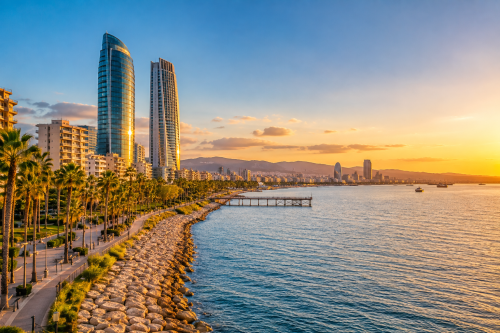
Located on the southern coast of Cyprus, Limassol boasts a rich and diverse history that reflects the island's remarkable past. Its origins date back to ancient times, and over the centuries the city has evolved under the influence of numerous civilizations, each leaving its mark on its culture, architecture, and traditions.
The Ancient Foundations of Limassol
The area surrounding Limassol has been inhabited since prehistoric times, with evidence of Paleolithic hunter-gatherer communities. The first permanent settlements appeared during the Neolithic period. To the east of modern Limassol lies the ancient city of Amathus, one of the island's most important kingdoms and a thriving commercial centre in antiquity. Limassol itself is believed to have developed after the destruction of Amathus by Richard the Lionheart in AD 1191.
Medieval Prosperity and the Crusades
Limassol's history is closely linked to the events of the Third Crusade. In 1191, Richard the Lionheart arrived in Cyprus and defeated Isaac Komnenos, the Byzantine ruler of the island. Following his victory, Richard celebrated his marriage to Berengaria of Navarre in Limassol, where she was crowned Queen of England.
In 1192, Cyprus was sold to the Knights Templar, but shortly afterwards it passed into the hands of Guy de Lusignan, marking the beginning of Frankish rule over the island. During the Lusignan period (1192–1489), Limassol flourished as a major port and became an important centre of trade, culture, and commerce, attracting merchants, pilgrims, and scholars from Europe and the Middle East.
Decline Under Ottoman Rule
In 1570, Cyprus came under Ottoman rule following the Ottoman invasion of the island. Limassol was captured without significant resistance, entering a period of relative decline as trade routes shifted and administrative priorities changed. Although the Ottomans restored parts of the town, their primary focus was on military needs rather than economic development.
Despite these challenges, Limassol maintained its mixed population of Greek and Turkish Cypriots throughout the Ottoman era. The Orthodox Church played a vital role in preserving education and cultural identity by establishing schools where Greek history and language were taught alongside other subjects.
The British Colonial Era: Growth and Modernisation
In 1878, Cyprus came under British administration, ushering in a new era of development for Limassol. The British invested heavily in the city's infrastructure, improving roads, expanding the harbour, and introducing modern utilities such as electricity and improved sanitation.
Tourism began to flourish after 1974, when many of Cyprus' traditional tourist destinations fell under Turkish occupation following the events of that year. As a result, Limassol emerged as one of the island's principal tourist destinations, while its port became a cornerstone of the Cypriot economy and international trade.
Modern Development and Cultural Significance
Today, Limassol is renowned for its vibrant cultural life and its importance as Cyprus' largest port city. It has grown into a cosmopolitan centre with a diverse international community and a thriving business environment. The city continues to prosper as a hub for commerce, shipping, and tourism while preserving its remarkable historical heritage through landmarks such as Limassol Castle and the archaeological sites of Ancient Amathus and Kourion.
The history of Limassol is more than a record of its past—it is an integral part of Cyprus' continuing story. Combining ancient roots with modern vitality, the city celebrates its rich cultural heritage while embracing innovation and growth. With its unique blend of history, culture, and contemporary energy, Limassol remains one of the island's most captivating destinations.