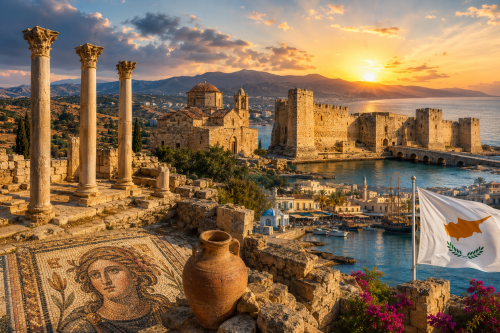
Cyprus, the third-largest island in the Mediterranean Sea, boasts a remarkable history spanning thousands of years. Situated at the crossroads of Europe, Asia, and Africa, this beautiful island has been shaped by numerous cultures and civilizations. Its strategic location made Cyprus a highly desirable territory for successive empires, each leaving a unique imprint on the island. Whether you are fascinated by ancient history, Greek mythology, or the modern era, Cyprus offers an extraordinary wealth of historical treasures.
Ancient Cyprus: The Dawn of Civilization
The history of Cyprus begins in the Neolithic period, around 9,000 years ago. Archaeological discoveries reveal that the island's earliest settlers cultivated the land and developed crafts, laying the foundations of Cyprus's rich cultural heritage. Copper, from which the island derives its name, became a vital trading commodity during the Bronze Age (c. 2500–1050 BC), connecting Cyprus to commercial networks across the Near East, Egypt, and the Aegean world. Today, visitors can explore the remains of these ancient settlements and thriving early communities.
Cyprus in Greek Mythology
One of the most iconic aspects of Cyprus's history is its connection to Greek mythology. According to legend, Aphrodite, the Greek goddess of love and beauty, emerged from the sea foam off the coast of Paphos, making the island an important spiritual and cultural centre of the ancient world. By the end of the second millennium BC, Mycenaean Greeks had settled in Cyprus, bringing with them the Greek language and culture, which continue to shape the island's identity to this day.
Cyprus Under Great Empires: From Persia to Rome
Throughout its history, Cyprus came under the rule of several powerful empires, including the Assyrians, Egyptians, and later the Persians in 545 BC. Although subject to Persian rule, the local kingdoms retained a degree of autonomy. It was only after Alexander the Great defeated the Persians in 333 BC that Cyprus became part of the Hellenistic world.
Following Alexander's death, Cyprus came under the control of the Ptolemaic Kingdom of Egypt and, in 58 BC, became a province of the Roman Empire. Roman rule brought stability and significant infrastructure projects, including roads and aqueducts, some of which can still be seen today. The Roman period also played a key role in the spread of Christianity across Cyprus, establishing the island as an important centre of the early Christian world.
Byzantine and Medieval Cyprus
After the fall of the Roman Empire, Cyprus became part of the Byzantine Empire in the 4th century AD. During this period, the island flourished as a centre of Christianity, and many of its famous churches and monasteries date back to this era. The Crusades also left a lasting mark on Cyprus, beginning in 1191 when Richard the Lionheart conquered the island. Cyprus was subsequently ruled by the Lusignan dynasty for more than 300 years, leaving behind magnificent medieval castles and Gothic architecture that continue to attract history enthusiasts from around the world.
Ottoman Rule and British Administration
In 1571, the Ottoman Empire conquered Cyprus and ruled the island for more than three centuries. The Ottomans introduced new administrative structures while allowing Orthodox Christianity to remain the dominant religion, although a Muslim community also developed during this period.
In 1878, Cyprus came under British administration, which introduced modern infrastructure and institutions. However, tensions between the Greek Cypriot and Turkish Cypriot communities gradually intensified, with increasing calls from many Greek Cypriots for Enosis—union with Greece.
Cyprus's Road to Independence and Modern History
Cyprus gained independence from Britain in 1960, establishing the Republic of Cyprus. However, the following years were marked by growing conflict between the island's Greek and Turkish communities. In 1974, a coup led by Greek nationalists prompted a Turkish military intervention, resulting in the division of the island—a situation that continues to this day.
Despite this division, the Republic of Cyprus has flourished as a modern European state and became a member of the European Union in 2004. Today, visitors can experience a unique blend of cultures and history, from ancient archaeological sites to vibrant modern cities.
Why Visit Cyprus?
Cyprus is far more than a destination for sun and sea—it is an island steeped in history and culture. From the ancient ruins of Kourion and the medieval castles of the Lusignan period to the legendary birthplace of Aphrodite, Cyprus offers an unforgettable historical journey. Whether your interests lie in ancient civilizations, medieval heritage, or the island's complex modern history, Cyprus promises a rich and rewarding experience unlike any other.