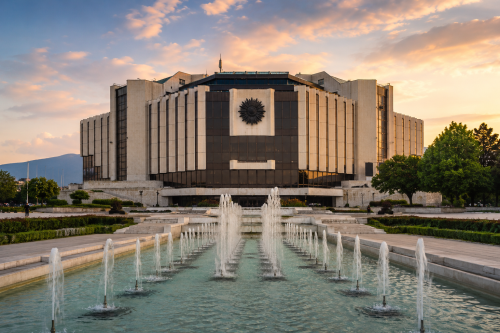
In the heart of Sofia, surrounded by gardens, fountains and the lively streets of Bulgaria’s capital, stands one of the city’s most recognizable modern landmarks: the National Palace of Culture, commonly known by its Bulgarian abbreviation NDK. Built during Bulgaria’s socialist period and officially opened in 1981, the National Palace of Culture represents a fascinating chapter in the country's 20th-century history. Today, it remains one of Sofia's most important venues for concerts, exhibitions, conferences, festivals and major cultural events. For travellers exploring Sofia, the National Palace of Culture offers something different from the city's Orthodox churches, Roman ruins and Ottoman-era landmarks. It provides an opportunity to discover modern Bulgarian architecture, socialist-era history and contemporary cultural life — all in one of the most pleasant areas of central Sofia.
Location of the National Palace of Culture
The National Palace of Culture is located at 1 Bulgaria Square, at the southern end of Sofia's central pedestrian area. Its location makes it particularly convenient for visitors exploring the city on foot. The famous Vitosha Boulevard, filled with restaurants, cafés and shops, begins nearby, while the surrounding NDK park provides a spacious green area in the middle of the capital. The complex is also easily accessible by public transport, including the NDK Metro Station. Because of its central location, NDK can easily be included as part of a walking tour through Sofia.
The History of the National Palace of Culture
The story of the National Palace of Culture begins in the 1970s, when Bulgaria's communist era authorities decided that Sofia needed a large modern cultural centre. The project was connected with the celebrations marking 1,300 years since the establishment of the Bulgarian state, which were held in 1981. The initiative emerged in the mid-1970s, and the project was eventually entrusted to a team led by Bulgarian architect Alexander Barov. The surrounding urban spaces were designed by another team led by architect Atanas Agura, while landscape architect Valentina Atanassova was responsible for the park area. Construction progressed remarkably quickly. The groundbreaking took place in 1978, and the complex was completed within approximately three years. The National Palace of Culture officially opened on 31 March 1981 as part of Bulgaria's 1,300th-anniversary celebrations. Until Bulgaria's political changes in 1989, the palace bore the name of Lyudmila Zhivkova, the former Bulgarian Minister of Culture and daughter of communist leader Todor Zhivkov.
An Impressive Example of Socialist-Era Architecture
One of the main reasons the National Palace of Culture is worth seeing is its monumental architecture. The building was conceived on an enormous scale. According to NDK itself, the complex covers approximately 123,000 square metres, with eight above-ground floors, panoramic terraces and three underground levels. Its construction required vast quantities of materials. Around 10,000 tonnes of metal structures were incorporated into the palace — an amount NDK compares to the quantity used in the Eiffel Tower. The result is an imposing building that reflects the architectural ambitions of Bulgaria during the late socialist period. For visitors interested in communist architecture, Cold War history and Eastern Europe, NDK is therefore much more than an events venue. The building itself is part of the historical experience.
Art Inside the National Palace of Culture
The National Palace of Culture was designed not simply as a functional building but also as a showcase for Bulgarian art. Its halls and foyers contain numerous works of monumental painting, sculpture and other forms of decorative art created by prominent Bulgarian artists. Sofia's official tourism organization describes the interior as a kind of museum of late-20th-century Bulgarian art. One of the building's most recognizable symbols is the large bronze Sun positioned above the main entrance. Created by Bulgarian sculptor Georgi Chapkanov, the seven-metre-high work draws inspiration from the decorative sun motifs found in traditional Bulgarian Revival-era houses. Inside the building, visitors can encounter additional monumental artworks that reflect the cultural ideals and artistic style of the period.
From Socialist Landmark to Modern Cultural Centre
Although the National Palace of Culture was created during communist Bulgaria, its story did not end with the collapse of the socialist political system in 1989. Instead, the complex successfully developed a new role in modern Bulgaria. Today, the National Palace of Culture continues to host concerts, international conferences, exhibitions, theatre performances, festivals and other cultural events. It remains one of the country's best-known venues for major Bulgarian and international performers. Over the decades, internationally known performers and musicians including José Carreras, Andrea Bocelli, Sting, Bob Dylan, Mark Knopfler, James Brown and Paco de Lucía have appeared at the venue. This combination of socialist history and contemporary cultural life makes NDK particularly interesting: it is not a preserved monument frozen in time, but a building that continues to play an active role in Sofia.
Why the National Palace of Culture Is Worth Visiting
Discover Sofia's Socialist-Era Heritage
Visitors often associate Sofia with landmarks such as Alexander Nevsky Cathedral, St. George's Rotunda and the city's Roman remains. The National Palace of Culture reveals another important layer of the capital's history — Bulgaria during the second half of the 20th century. For anyone interested in socialist architecture or communist-era Bulgaria, the National Palace of Culture is an important stop.
Experience One of Sofia's Most Recognizable Landmarks
Its enormous scale and distinctive architecture make the National Palace of Culture one of the most recognizable buildings in modern Sofia. Even if you are not attending an event inside, the exterior and surrounding square are worth exploring.
Walk Through the Park of the National Palace of Culture
The large open spaces and gardens surrounding the National Palace of Culture offer a pleasant contrast to the busy city streets. The area is popular for walking, meeting friends and relaxing, giving travelers an opportunity to experience a part of everyday life in Sofia.
Combine Your Visit with Vitosha Boulevard
One of the advantages of visiting the National Palace of Culture is its proximity to Vitosha Boulevard, Sofia's best-known pedestrian shopping and dining street. You can easily combine sightseeing at the National Palace of Culture with shopping, coffee, lunch or dinner along Vitosha. This makes the National Palace of Culture particularly convenient to include in a relaxed half-day exploration of central Sofia.
National Palace of Culture and Communist Sofia
Travelers interested in Bulgaria's communist past can also include the National Palace of Culture as part of a broader exploration of socialist Sofia. The building tells a different story from monuments dedicated directly to communist political leaders or the Soviet Union. Instead, the National Palace of Culture demonstrates how the socialist state used architecture, art and enormous public projects to express ideas about national identity, culture and modernization. Its construction transformed what had previously been a poorly developed part of central Sofia into a major urban and cultural space. Combined with other communist-era attractions in Sofia, the National Palace of Culture helps visitors gain a deeper understanding of how the city developed during the second half of the 20th century.
What to See Near the National Palace of Culture
Thanks to its central location, the National Palace of Culture can easily be combined with several other attractions during a day in Sofia. From the palace, visitors can walk along Vitosha Boulevard towards the historical centre, where many of Sofia's major landmarks can be found. The surrounding area also offers numerous cafés, restaurants and shopping opportunities, making it an excellent place to spend part of an afternoon or evening. For travelers who prefer a relaxed itinerary, a visit to the National Palace of Culture followed by a walk along Vitosha Boulevard provides an enjoyable combination of history, architecture, shopping and modern city life.
Discover Sofia and Bulgaria with Over Sun Aviation
Sofia is a city where more than two thousand years of history can be discovered within a relatively small area. Roman ruins stand beside Orthodox churches, elegant early-20th-century buildings coexist with monumental socialist architecture, and modern cafés and shopping streets bring new life to the historic centre. The National Palace of Culture represents an important part of this fascinating historical journey.
With Over Sun Aviation, discover Sofia beyond the usual tourist attractions and explore the monuments, neighborhoods and stories that reveal the many different faces of Bulgaria's capital.