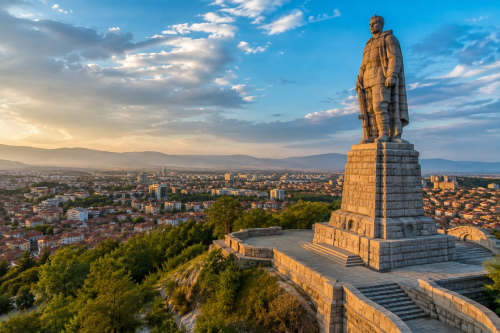
Rising high above Plovdiv on the top of Bunardzhik Hill stands one of the city’s most recognizable and historically significant landmarks: the Alyosha Monument. The imposing figure of a Soviet soldier is one of the best-known monuments associated with Bulgaria’s socialist period. Today, visiting Alyosha offers travelers an opportunity to discover a different side of Plovdiv — beyond its famous Roman ruins and charming Old Town. A visit combines 20th-century history, architecture, a pleasant walk and panoramic views over Plovdiv, making it an interesting addition to any sightseeing itinerary.
Location of the Alyosha Monument
The Alyosha Monument stands on Bunardzhik Hill, also known as the Hill of the Liberators, close to the center of Plovdiv. Bunardzhik is one of the distinctive hills that shape Plovdiv’s landscape. Today, it is a green recreational area with walking paths and steps leading towards the monument at the summit. The walk to the top is part of the experience. Once there, visitors are rewarded with impressive panoramic views across Plovdiv and the surrounding landscape.
The History of the Alyosha Monument
The monument was created during Bulgaria’s socialist period and is dedicated to the Soviet soldier. Construction took place during the 1950s, with the monument officially unveiled in 1957. Its most striking feature is the enormous granite figure of a Soviet soldier, standing approximately 10.5 metres high. The soldier is depicted holding a Shpagin submachine gun with its barrel pointing towards the ground. Together with its massive pedestal and prominent position on Bunardzhik Hill, the monument dominates this part of Plovdiv’s skyline and can be seen from many areas of the city.
The Story Behind the Name “Alyosha
Although officially created as a monument to the Soviet soldier, it became popularly known among local people simply as “Alyosha.” Alyosha is an affectionate Russian form of the name Alexei. Over the decades, the name became so closely associated with the monument that today both locals and visitors generally refer to it as the Alyosha Monument. The figure represented by the monument has traditionally been associated with Soviet soldier Alexei Skurlatov, although the monument itself was intended to symbolize the Soviet soldier more broadly.
A Monument from Socialist Bulgaria
For modern visitors, Alyosha is particularly interesting because it provides a tangible connection with the period when Bulgaria was part of the Soviet-led Eastern Bloc. Following the Second World War, Bulgaria underwent profound political and social changes. Monumental architecture became an important way of expressing the values and historical narratives promoted by the socialist state. Across Bulgaria, monuments, statues and large public buildings were constructed to commemorate political figures, historical events and the relationship between Bulgaria and the Soviet Union. The Alyosha Monument is one of the most recognizable surviving examples of this period in Plovdiv.
Alyosha and the Legacy of the 20th Century
Like many communist-era monuments across Central and Eastern Europe, Alyosha is more than simply another tourist attraction. It represents a period of history that continues to be interpreted differently. For some, the monument commemorates the defeat of Nazi Germany and the Soviet contribution to victory in the Second World War. For others, it represents the beginning of decades of Soviet influence over Bulgaria and the communist political system that governed the country until 1989. Understanding these different perspectives makes a visit particularly interesting for travelers interested in history, politics, geopolitics and the Cold War. Rather than presenting a simple historical narrative, Alyosha provides an opportunity to think about how different generations remember the turbulent history of 20th-century Europe.
Why the Alyosha Monument Is Worth Visiting
There are several reasons to include Bunardzhik Hill and the Alyosha Monument in your Plovdiv itinerary.
Discover a Different Side of Plovdiv
Plovdiv is famous for its ancient Roman heritage, but its history did not end in antiquity. Visiting Alyosha allows travelers to explore a much more recent chapter in Bulgaria’s story and better understand how the country changed during the 20th century.
Explore Bulgaria's Socialist Heritage
Travelers interested in communist history, the Cold War and Eastern Europe will find Alyosha particularly fascinating. Together with other socialist-era monuments around Bulgaria, it provides an insight into the architecture, ideology and political symbolism of the period.
Enjoy Panoramic Views of Plovdiv
The location itself is another excellent reason to visit. From the top of Bunardzhik Hill, visitors can enjoy beautiful views across Plovdiv, making the area particularly attractive for photography and sightseeing.
Combine History with a Pleasant Walk
Bunardzhik Hill is also a green and peaceful part of the city. The walk towards the monument provides an opportunity to escape the busy streets for a while and combine sightseeing with some time outdoors.
Plovdiv Beyond Its Ancient History
One of the most fascinating things about Plovdiv is the extraordinary number of historical periods that coexist within the same city. During a single visit, travelers can discover Roman ruins, Bulgarian Revival houses, Orthodox churches, Ottoman influences and monuments from the socialist period. The Alyosha Monument adds another layer to this story. It reminds visitors that modern Plovdiv was shaped not only by its ancient civilizations but also by the wars, political transformations and ideological conflicts of the 20th century.
For travellers who want to understand Bulgaria rather than simply photograph its most famous attractions, these layers of history make Plovdiv an especially rewarding destination.
Discover Plovdiv and Bulgaria with Over Sun Aviation
A visit to the Alyosha Monument can easily form part of a broader journey through Plovdiv and Bulgaria's historical heritage.
From Plovdiv's magnificent Roman Theatre and atmospheric Old Town to the landmarks left behind by the socialist period, the city offers visitors a fascinating journey through more than two thousand years of history.
With Over Sun Aviation, discover a different side of Bulgaria and explore the places, monuments and stories that have shaped the country we see today.