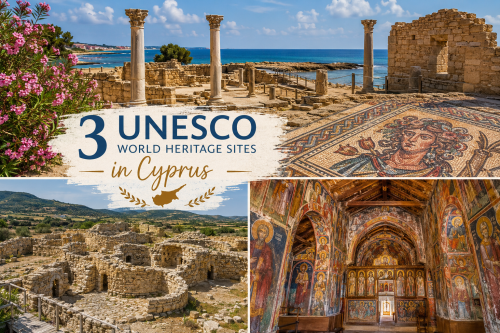
Cyprus is famous for its crystal-clear waters, golden beaches, and year-round sunshine, but the island is also one of the Mediterranean's richest cultural destinations. With a history spanning more than 9,000 years, Cyprus is home to civilizations that have shaped Europe, the Middle East, and the Mediterranean world. Recognized for its outstanding cultural significance, Cyprus is home to three UNESCO World Heritage Sites. These remarkable places preserve prehistoric settlements, magnificent Roman monuments, and some of the world's finest Byzantine churches.
Whether you're passionate about history, archaeology, photography, architecture, or simply looking to discover the authentic side of Cyprus, these UNESCO sites deserve a place on your itinerary.
Paphos Archaeological Site – The Jewel of Ancient Cyprus
The Archaeological Site of Paphos is undoubtedly Cyprus' most famous UNESCO World Heritage Site and one of the Mediterranean's greatest archaeological treasures. Inscribed on UNESCO's World Heritage List in 1980, this extraordinary site preserves the remains of the ancient city of Nea Paphos, once the capital of Cyprus during the Roman period. According to Greek mythology, the surrounding region is closely associated with Aphrodite, the Goddess of Love, making it one of the island's most legendary destinations. Today, visitors can explore remarkably preserved Roman villas, temples, theatres, ancient streets, and some of the finest mosaics ever discovered.
What to See During Your Visit
House of Dionysos
One of the most famous attractions in Cyprus, this Roman villa is renowned for its spectacular mosaic floors depicting scenes from Greek mythology. Dating back to the 2nd century AD, these mosaics are among the best preserved anywhere in the world.
House of Theseus
Believed to have been the residence of the Roman governor, this impressive villa features elegant courtyards and magnificent mosaic artwork.
House of Aion
Although smaller, it contains some of Cyprus' most sophisticated Roman mosaics, admired for their artistic detail.
Roman Odeon
This beautifully restored Roman theatre still hosts concerts and cultural performances during the summer months.
Tombs of the Kings
Located nearby, these monumental underground tombs were carved directly into solid rock during the Hellenistic period. Despite their name, they were used by aristocrats rather than kings.
Visitor Tips
- Allow 3–4 hours to explore the site.
- Visit early in the morning during summer.
- Wear comfortable walking shoes.
- Bring water, sunscreen, and a hat.
Why Visit?
- World-famous Roman mosaics
- Rich Greek mythology
- Stunning archaeological remains
- Beautiful coastal setting
Choirokoitia – Travel Back 9,000 Years
Few places in Europe allow visitors to travel so far back in time as Choirokoitia. Recognized by UNESCO in 1998, this exceptionally well-preserved Neolithic settlement dates back to around 7000 BC, making it one of the oldest prehistoric villages in the Mediterranean. Long before writing, metal tools, or large cities existed, the people of Choirokoitia had already built organized communities using circular stone houses surrounded by defensive walls. Today, visitors can walk among the archaeological remains and explore reconstructed dwellings that offer a fascinating insight into daily life thousands of years ago.
What to See During Your Visit
- Reconstructed Neolithic houses
- Ancient defensive walls
- Archaeological excavation areas
- Visitor centre
- Scenic countryside setting
Walking through Choirokoitia offers a rare opportunity to experience one of Europe's earliest farming communities.
Visitor Tips
- Plan around 2 hours for your visit.
- Visit during spring or autumn for cooler temperatures.
- Combine your trip with nearby Lefkara, one of Cyprus' most beautiful traditional villages.
Why Visit?
- Nearly 9,000 years of history
- One of Europe's oldest settlements
- Family-friendly educational experience
- Outstanding archaeological importance
The Painted Churches of the Troodos Region – Hidden Byzantine Masterpieces
Nestled among the forests and mountain villages of the Troodos Mountains lies one of Cyprus' greatest cultural treasures. The Painted Churches of the Troodos Region were inscribed on UNESCO's World Heritage List because of their extraordinary collection of Byzantine wall paintings dating from the 11th to the 16th centuries. Unlike the grand cathedrals of Europe, these churches appear simple from the outside. Step inside, however, and you'll discover interiors completely covered with vibrant frescoes that have survived for centuries. Together, they represent one of the world's finest collections of Byzantine religious art.
Some of the Most Beautiful Churches Include
Agios Nikolaos tis Stegis
Located near Kakopetria, this is perhaps the best-known of the UNESCO churches, with stunning frescoes covering almost every surface.
Panagia tou Araka
Hidden in the village of Lagoudera, this church contains some of the finest Byzantine paintings in Europe.
Church of Archangel Michael
Situated in Pedoulas, this charming church is famous for its beautiful wooden roof and well-preserved artwork.
Panagia Podithou
A beautiful example of post-Byzantine architecture surrounded by peaceful mountain scenery.
Timios Stavros, Pelendri
One of the most impressive churches in the UNESCO collection, combining remarkable frescoes with traditional mountain architecture.
Visitor Tips
- Rent a car to explore the Troodos Mountains.
- Allow a full day to visit several churches.
- Dress modestly.
- Combine your visit with traditional villages and local taverns.
Why Visit?
- UNESCO-listed Byzantine frescoes
- Beautiful mountain scenery
- Authentic Cypriot villages
- Peaceful cultural experience
Why These UNESCO Sites Make Cyprus So Special
Few countries offer such a remarkable journey through human history within such a compact island.
Together, Cyprus' UNESCO World Heritage Sites tell the story of:
- The island's earliest inhabitants
- Ancient Greek mythology
- Roman civilization
- Early Christianity
- Byzantine artistic excellence
- Traditional mountain life
Whether you spend a weekend or two weeks in Cyprus, these extraordinary places provide a deeper understanding of the island's rich cultural heritage.
Discover Cyprus' UNESCO Heritage with Over Sun Aviation
At Over Sun Aviation, we believe that the most memorable holidays are those that combine relaxation with discovery. Our carefully designed Cyprus tours take you beyond the beaches to explore the island's UNESCO World Heritage Sites, picturesque mountain villages, archaeological treasures, traditional taverns, and breathtaking landscapes.
Whether you're passionate about history, archaeology, photography, or authentic cultural experiences, we'll help you discover the very best that Cyprus has to offer.
Book your Cyprus holiday today and experience why UNESCO has recognised Cyprus as one of the Mediterranean's most fascinating cultural destinations.